
Sorry, but your login has failed. Please recheck your login information and resubmit. If your subscription has expired, renew here.
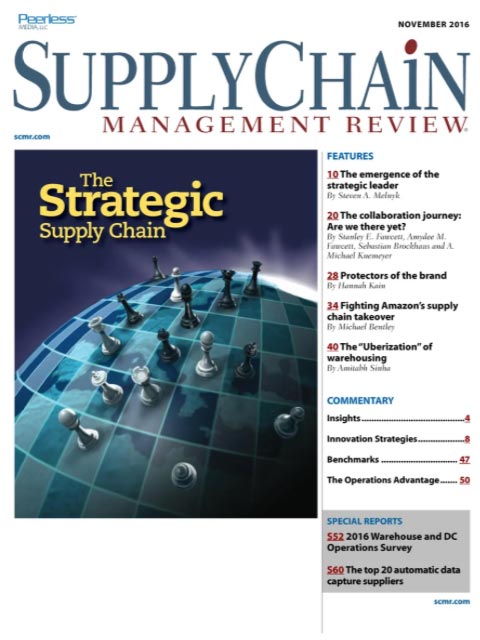
November 2016
Is supply chain management strategic or tactical? Are the best supply chains collaborative? Should the goal be an integrated supply chain or an integrative supply chain? The answers are a mixed bag, according to this month’s contributors. Browse this issue archive.Need Help? Contact customer service 847-559-7581 More options
In late 2015, Amazon received a license from the U.S. government to act as a freight forwarder for ocean container shipping. That approval came on the heels of Amazon winning a similar license from the Chinese Ministry of Commerce. Armed with licenses from both countries, the online retailer is now positioned to buy space on container ships at wholesale rates and resell at retail rates, which will allow the company to connect two of the world’s largest markets while cutting out competitors.
Then came another bold step: Amazon signed a deal with Air Transport Services Group to lease 20 Boeing 767 aircraft to shuttle merchandise around the U.S. as part of the online retailer’s efforts to reduce its high shipping expenses. Combined, these moves confirm earlier reports that Amazon is planning a global expansion of its “Fulfillment by Amazon” service, which provides storage, packing and shipping to small independent merchants that sell products on Amazon’s Website—a project dubbed “Dragon Boat.”
By signing the Air Transport Services Group deal and receiving a license to act as a wholesaler for ocean container shipping, Amazon once again can reduce its inflated shipping costs and reliance on third-party logistics providers. As evident from the recent Hanjin bankruptcy, shipping and air cargo companies can expect to see a continued shrinking market as Amazon enters the fray.
Just as Amazon’s retail competitors have had to develop new strategies in order to survive, Amazon’s newest competitors will need to determine what they can learn from the online retail conglomerate, and then move resources to the most advantageous and vulnerable areas of their industry.
SC
MR
Sorry, but your login has failed. Please recheck your login information and resubmit. If your subscription has expired, renew here.
November 2016
Is supply chain management strategic or tactical? Are the best supply chains collaborative? Should the goal be an integrated supply chain or an integrative supply chain? The answers are a mixed bag, according to this… Browse this issue archive. Access your online digital edition. Download a PDF file of the November 2016 issue.
 |
Download Article PDF |
In late 2015, Amazon received a license from the U.S. government to act as a freight forwarder for ocean container shipping. That approval came on the heels of Amazon winning a similar license from the Chinese Ministry of Commerce. Armed with licenses from both countries, the online retailer is now positioned to buy space on container ships at wholesale rates and resell at retail rates, which will allow the company to connect two of the world's largest markets while cutting out competitors.
Then came another bold step: Amazon signed a deal with Air Transport Services Group to lease 20 Boeing 767 aircraft to shuttle merchandise around the U.S. as part of the online retailer's efforts to reduce its high shipping expenses. Combined, these moves confirm earlier reports that Amazon is planning a global expansion of its “Fulfillment by Amazon” service, which provides storage, packing and shipping to small independent merchants that sell products on Amazon's Website—a project dubbed “Dragon Boat.”
By signing the Air Transport Services Group deal and receiving a license to act as a wholesaler for ocean container shipping, Amazon once again can reduce its inflated shipping costs and reliance on third-party logistics providers. As evident from the recent Hanjin bankruptcy, shipping and air cargo companies can expect to see a continued shrinking market as Amazon enters the fray.
Just as Amazon's retail competitors have had to develop new strategies in order to survive, Amazon's newest competitors will need to determine what they can learn from the online retail conglomerate, and then move resources to the most advantageous and vulnerable areas of their industry.
|
|
SUBSCRIBERS: Click here to download PDF of the full article. |
SC
MR

Latest Supply Chain News
- Schneider Electric again tops Gartner’s Top 25 Supply Chain rankings
- The real reason supply chain tech ROI falls short
- Why supply chains fail at launch: It’s not the plan, it’s the execution
- NextGen 2026 Keynotes announced
- DHL Supply Chain bets on data foundations, robotics, and agentic AI to drive growth
- More News
Latest Podcast

 Explore
Latest Supply Chain News
- Wayfair executive to share lessons from building a tech-driven delivery network in NextGen Keynote
- Surging AI adoption doesn’t match mass layoff narrative
- Tillamook turns supply chain planning into growth engine
- Schneider Electric again tops Gartner’s Top 25 Supply Chain rankings
- The real reason supply chain tech ROI falls short
- Why supply chains fail at launch: It’s not the plan, it’s the execution
- More latest news
Latest Resources
Subscribe

Supply Chain Management Review delivers the best industry content.

Editors’ Picks



